Our focus this week was based on looking at the heart rates after doing certain physical activities. First, we looked at our prior knowledge about the heart rates. After this, we wrote down some questions which were about what we wanted to know about heart rates. When writing the questions, we wrote our hypothesis (what we thought the answer to the questions were). Our investigation part consisted of completing the 6 activites: sitting, jogging, throwing/catching, stretching, star jumps and running. My hypothesis was about how I thought running on the spot will cause my highest blood rate. I enjoyed this investigation because I am interested in blood pressure. One thing I learned was that blood rate is measured in mmHg.
Showing posts with label Science. Show all posts
Showing posts with label Science. Show all posts
Friday, 13 August 2021
My Science Investigation
LI: to investigate the effect of different types of physical activities on heart rate.

Friday, 6 August 2021
My Science Investigation
LI: to research about the taste buds of the tongue.
Our focus this week was based off of looking at the different tase buds located on the tongue. First we looked at our prior knowledge of taste buds. After doing so, we filled out the table that had steps 1-7. We looked at the investigation/research part. After that, we came up with questions that we wanted to be answered at the end of the experiment. Then we wrote down our hypothesis (what we think the answers to our questions are).
Next we did some research about the taste buds and how sensitive they can be. The five taste buds are: sour, sweet, bitter, salt and savory. How these taste buds work is when the food/drink makes contact with your taste buds, the taste buds will know what the taste will be depending on the type of food/drink. For example: if I drink lemon juice, the lemon juice will make contact with the sour taste buds and notify my brain of the taste.
To find out the taste of certain solutions, we got spoons and put the different solutions on them. Then we tasted the solutions. If the majority of us had the same taste, we put a tick on the part where we tasted. If someone didn't have the same taste as us, we wrote down their name. This gave us a conclusion of how everyone has different taste buds.
I enjoyed this weeks science project because it taught me things I did not know about the tongue.
Friday, 30 July 2021
Topic 8 - Acids and Bases
LI: to learn about acids and bases.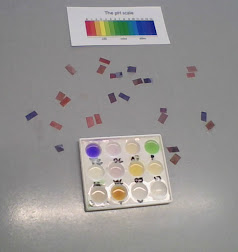
Our focus today was about looking at the acidity/base level of different substances. We got into partners and answered some questions using our prior knowledge. After this, we looked at the different substances we would be using today.
In order to measure the pH balance or scale we used litmus. Litmus is a piece of paper that has the ability to change colours depending on the acidity, base or neutral level of a certain substance. If you take an acidic substance and dip the red litmus paper into it, it will stay the same or get even more darker. If you dip the blue litmus paper into the acidic substance, and it turns red, it is acidic. We tested 11 substances. Before testing them out with the litmus paper, we predicted what substances are acidic, neutral or basic. After that, we tested them out and checked to see if our predictions were correct. I enjoyed this activity a lot because I am familiar with pH balances.
Friday, 9 July 2021
Tech | Osmosis and Transpiration
LI: to learn about the process of osmosis and transpiration.
Today, our focus was based on looking at the osmosis and transpiration of a plant (celery). Our first task was to look at the photosynthesis cycle. The photosynthesis cycle helps a plant create their food. The leaves are the ones to create the food. The ingredients a leaf needs are: sunlight, water (H20) and carbon dioxide. All of these ingredients create sugar/glucose. Our second task was based off of the celery and food colouring experiment. We watched a video about how to conduct this experiment. We needed to observe how the water travels through the xylem to the leaves and back from the phloem. The coloured water helped us see the xylems. I found this activity very interesting and I did not know that water travels through xylem in order to get to the leaves.
Friday, 2 July 2021
Tech | Bubble Science
LI: to conduct a scientific experiment about bubbles.
Our focus today, was to conduct a scientific experiment about bubbles. We first talked about our learning goal/outcome. The learning goal was to understand the science of bubbles. After that, we needed to learn about the science behind the bubbles. Bubbles have 3 layers. 2 of the layers are soap and one of them is water, it is like a sandwhich. Water particles attract to each other so when the soap is mixed along with the water, it reduces how much the water particles are attracted to each other. After that, we looked at the bubble challenges. They were: caterpillar, courasel and cube. By the end of this experiment we were able to talk about the results of the experiment. I managed to do all of these challanges.
Friday, 25 June 2021
Science | Dissecting Hibiscus
LI: to learn about the different parts of a hibiscus flower.
Today, the year 7's went to tech to dissect a hibiscus flower. Our first task was based around our prior knowledge of the flowers. We answered two questions like: "What are your thoughts about flowers?" and "What have you noticed about flowers?". We did not have that much knowlegde about flowers.
After this, we identified the parts of a hibiscus as our second task. On the right side, there is a stigma, style, anther, pollen tube, sepal and thalamus. On the left side, there was the male gametophyte, petal, ovule and female gametophyte.
The next task was to dissect the flower. We used tools like: knife, cutting board and toothpick, We carefully removes one petal and one sepal. After this, we pinched the sides of the ovary and made a smooth cut down the middle. Then we removed the entire organ of from the style.
While dissecting the flower, we saw the pollens. We placed one or two pollens to see them under a microscope.
I learned the many parts of a flower. I found it interesting that female and male cells are shared throughout a single flower.
Friday, 18 June 2021
Topic 4 | Floating & Sinking
LI: to test the buoyancy of different materials.
Our focus for this week at science was about testing the buoyancy of different materials. First we discussed why some things float/sink/semi-float. Floating is the action of an object staying above water. Sinking is when something is unable to stay above water due to the density of it. Semi-float is when an object has the ability to both float and sink at the same time. We watched a video that explained what buoyancy/buoyant is. Buoyancy is the tendency of something that can float in water or a substance.
After this, we gathered our materials and looked at the size of it, weight of it and what the object is made out of. We also made predictions on whether each object would sink or not. A prediction is an educated guess of something. Some of our objects were: cube, marble, tennis ball, rectangle block, plastic block and etc
We filled up our buckets up to 2/3 and started our experiment. My parnter and I started from the smallest objects up to the largest objects. Some of our predictions were correct. We noticed that the wood materials had the ability to semi-float. The plastic materials had the ability to float and the rubber materials could float/sink.
I really enjoyed this experiment because it gave us the opportunity to learn about new things to do with buoyancy and sinking. One thing that I learned was that some objects have the ability to semi-float. I found this fact very interesting and cool.
Friday, 11 June 2021
Science Exploration Topic 3 (Tech)
LI: to test how long it can take for sugar to dissolve in hot or cold water.
This week for our technology session, we looked at the amount of time it takes for sugar to dissolve in different tempatures of water. Our first experiment required cold water. We measured 100 ml of cold water into the beaker then looked at the tempature of the water which was 20°C. After this, we weighed 10 grams of sugar. To do this, we needed to place some sugar onto the Petri dish and transport that onto our weighing scale. We then poured our exact measurement of sugar into the cold water and mixed while looking at the amount of time it takes to dissolve with a stopwatch. It took the sugar 59.66 seconds for it to dissolve into the water making a solution. We did the same thing all over again but with hot water. The tempature was 75°C and the time it took to dissolve was 17.10 seconds.
I enjoyed this activity very much because I am familiar with measuring water and weighing different types of materials/things. I learned that a solution is when a solid is mixed in with a liquid. I really enjoyed the part where we needed to measure 10 grams of sugar.
Friday, 4 June 2021
Science (Tech)
LI: To measure water using meniscus.
Today for Tech with Miss Sharmal, we explored the basic science laboratory equipment and performed an experiment based off of meniscus.
We found out that meniscus is the curve of water that occurs when water is inside of a beaker or measuring cylinder. A meniscus can cause improper measurements. The bottom of the meniscus (where the water is flat surfaced) can be measured instead to perform accurate measurements.
We used a beaker to measure 100ml of water and transferred 40ml of water to a measuring cylinder. We used a pipette to make sure our measurement was exact using our knowledge of meniscus. Then, we added 3 more ml of water to the measuring cylinder using the pipette.
I found this task easy because I am familiar with science/laboratory equipment and I enjoyed performing the experiment of measuring and exploring meniscus.
Monday, 10 May 2021
Isaac Newton
LI: to learn about Isaac Newton.
This week in Reading, LS2 has been working towards Simple Machines. Apart of this, we were required to learn about Isaac Newton. Isaac Newton is a physicist, mathematician, theologian and an Astronomer. We were also required to create a DLO with the following questions: Why is his work important? What did he find out? How does his work connect to simple machines?
I found this interesting because I learnt more and new facts about Isaac Newton.
Monday, 14 December 2020
Summer Learning Journey | Scavenger Hunt
The first Nanogirl task required us to scavenger for different types of materials.
In our groups, we worked together to look for different items around the classroom. Our group managed to find 6/7 items. The item we did not manage to find was a mixing tool. The things we could have used were popsicle sticks and spoons.
By watching the video Nanogirl has provided us, I found out that an alternative for a roll was paper or cardboard rolled up. There are also many other materials people can use as an alternative.
I enjoyed looking for the different items.
Tuesday, 11 February 2020
About Me 2020
Salaam Alaikum.
My name is Farzana. I am Afghani. I am a year 6 in LS1 at Panmure Bridge School. I enjoy working on digital learning objects on my chromebook at school. At home I enjoy riding my skateboard. My favourite book is Harry Potter and the Philosopher's Stone. My favourite authors are J.K Rowling and Roald Dahl.
Subscribe to:
Posts (Atom)