Showing posts with label Reading. Show all posts

Thursday, 2 September 2021

Summary Customised Shoes

LI: to explain in fewer words what the text is about.
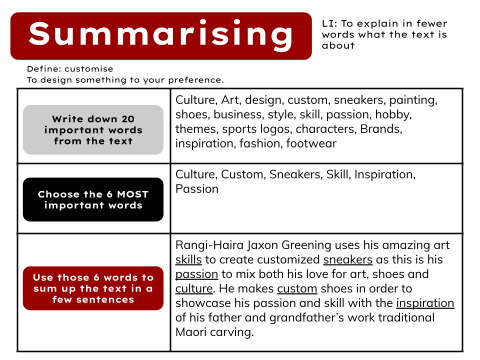
Our challenge today was based on looking at the work Rangi-Haira Jaxon Greening creates. Rangi-Haira showcases his skills by painting custom designs on shoes with the inspiration of the traditional Maori carving his grandfather and father had done. We read an article that explained what Rangi-Haira had done with his work in order to create a summary. By reading the artice, we could gather 20 keywords, narrow it down to 6 keywords and then create a summary which had all the important main points. I found it interesting how passionate Rangi-Haira is while working with shoes and designing shoes.

Recreating Famous Artworks

LI: To use your knowledge of colour and colour mixing to replicate the colours used in the artworks.

This week we have been learning about famous artworks and colour mixing. The artwork I chose was 'The Girl with the Pearl Earring' by Johannes Vermeer. This artwork was painted in 1665. It was painted as a symbol of purity and innocence. Today it can be found in Mauritshuis, a museum in The Hagues, Netherlands and is to permanently stay there. I enjoyed this challenge because we got to pick our own famous artwork and I really enjoy digital artwork.

Tuesday, 24 August 2021

Letter Q

LI: to evaluate.

This week we read about the origin of the Letter Q, and where it came from. Our task was to create a DLO (Digital Learning Object) to identify words that begin with the Letter Q. Once we had done that we identified the words we didin’t know and defined these. I found out about a few words starting with the letter Q and the meanings of some of them. I enjoyed the looking for these words.

Monday, 16 August 2021

Ancient Greek Olympics Presentation

LI: to skim and scan to find facts about the Ancient Olympics and make notes in my own words.


We used our reading time this week to find out about the Ancient Greek Olympics. Once we had made our notes and reorganised our information we collaboratively created a presentation. I found out that if women were caught in the olympics, they would get thrown off Mt. Olympus. This was a form of punishment due to the fact that women were forbidden from entering the Olympics because men would compete naked. I enjoyed finding out the information for this activity because it was fun and very informational.

Friday, 30 July 2021

Y-Chart

LI: to make inferences about the events in the text using clues provided by the author.

Our focus was based around inferring what athletes were thinking, seeing and wondering during the Olympics. In order to do this, we looked at an image which had information that we could point out to form our inferences. By looking at the images, we could see that the athletes had completed the swimming and are taking an after photo. Some inferences we made for feel/see were: the athletes might have felt nervous and cold, they could have been proud of what they accomplished, seeing their names of the scoreboard and how they felt determined to win. 

The image shown on the DLO was of Violet Walrond and other athlete competitors. Violet Walrond was a young athlete who competed in the Olympics at the age of fifteen. She was the youngest and first ever swimmer in New Zealand to use the crawl technique. Violet also was the first female to compete in the Olympics, representing New Zealand.

Thursday, 29 July 2021

Provocation | Olympic Money

LI: to use provocation to understand both sides of a story.

Our focus this week for reading was based on the Olympics & provocation. We used provocation to understand both side of the question asked. The question was should host countries spend so much money on building the Olympic venues? Our opinion was that host countries should not spend a massive amount of money on the olympics, since the former buildings used to host the olympics. We think that the billions of dollars used to other countries are facing difficult times. We found this task interesting because seeing both side of the story meant different people see the story with different opinion.

Tuesday, 29 June 2021

Liberty

LI: to edit our writing using DRAFT.

Today's focus was about editing our abstract noun poems. We used the procedure DRAFT, which stands for delete, rearrange, add, fix and talk. First, we talked about what abstract noun poems include in them. In an abstract noun poem, there are things like: the 5 senses, an abstract noun, punctuation, complex sentences and compound words. We chose the abstract noun 'liberty'. Liberty means to be free or freedom. We chose this noun because we thought it was an easy noun to describe. We paired up with another pair and practiced 'DRAFT' with them. We deleted the unnecessary words, rearranged the sentences, added more words that were missing, fixed the sentences and read the poems to our other pair. I thought this activity was fun and enjoyable.

Monday, 28 June 2021

Forming an Opinion

LI: To consider both perspectives.


For this task we chose one of the seven places  Maori in legends and looked at the evidence for the stories being real or not. After we have looked at the evidence we as a group were tasked to form an opinion about the place and if we think if the stories are real or not.

Main Ideas

LI: to identify the main ideas in the text.


For this task we watched a video about the story of how maui slowed the sun. From this video we had to pick the ideas in the video, the four main ideas in the story and the three main ideas of the story. The main idea is the point of a text, story, book, etc..

Venn Diagram

LI: to find as many similarities and differences as you can between the video and the text of “The Beginning”.


For this task we compared the text “The beginning” and the video of rangi and papa’s story on a Venn Diagram. A venn diagram is used to show the similarities and differences between two or more things, the parts of the circle that overlap the other are for writing similarities and the parts that do not overlap are for writing the differences between the two things.

Summarising

LI: to explain in fewer words what the text is about.

A summary is a quick and short way to explain the main points of a story or text. For this activity we watched a Video about Rangi and Papa and their story. From the video we had to choose twenty important words from the story. Then we chose the six most important words and wrote a short summary that tells the reader what the story is about.

Friday, 18 June 2021

Story Web

LI: to practise oral language.


LS2 has been practicing their oral language skills and to do this, we created a story web. We picked a story and choose the seven main scenes that would tell the story. I chose to draw scenes from 'The Boy Who Cried Wolf'. This story is about a boy who got bored while keeping track of his sheep so then he shouted "WOLF" down to his village. A man from the village came to look for the wolf but there was no wolf in sight. The man got angry and ran back to his village telling everyone what happened. The boy got bored again and decided to repeat the same process by shouting "WOLF". Another man came up to the boy and didn't see any wolves around. He went back to the village and told people again. While keeping track of the sheep, a wolf appeared. The boy shouted "WOLF" down to his village but no one came due to the fact that he tricked the men in the village. The moral of the story is to not lie out of boredom because if your lie becomes true, no one will believe you. The purpose for this activity was to look at your drawings and explain it without any wors. I really enjoyed this activity and it helped me explain more things in better detail.

Thursday, 10 June 2021

Afghanistan Brochure

LI: To create a brochure advertising a truthful visit at Afghanistan.


Our reading focus was around Afghanistan and creating informed opinions on a text or informative article. The text we explored was focused around attracting tourists despite the recent dangers and attacks that have been occurring in Afghanistan. 

Our creative task was to construct  an informative brochure that could persuade foreigners to visit Bamyan, Afghanistan on an escorted tour. 

We read through the article and shared our thoughts using information that we knew about the topical issue. We used different reading comprehension strategies to comprehend the text in a more clear and direct way so that we can make an educated opinion. We also used questions to help us understand the text better, skimming and scanning to evaluate the text even more and summarising in order to retell the text with our own form of comprehension. 

I found this task fairly easy because I am familiar with creating persuasive brochures that advertise an area, and I was able to use my prior understanding of a text to make and share my formed opinions with others.

Friday, 4 June 2021

Book Week

LI: to celebrate reading. 

Our school had book week where we celebrated our reading. Today, each student had the opportunity to dress up as a book character. I decided to dress up as Velma from Scooby Doo because Scooby Doo is one of the books I enjoyed reading a lot. Many people came dressed up as different characters. We had our Book Week Assembly and a person dressed up as Spider-Man came and taught us about some books. After the book week assembly, we went outside and read books with some juniors from room 4 and 2. I enjoyed this week and especially today because I got to dress up as a character. 

Wednesday, 2 June 2021

My Reading Pathway

LI: to show my personal journey through books.

This week is book week at Panmure Bridge School, which means every class participates in a number of reading activities. One of our activities was to create a reading pathway that shows how my favourite books have changed over time. At the moment I like reading 'The Witches' because it is a very interesting story and although there are very few illustrations they are still really good. 

Tuesday, 18 May 2021

Provocation

LI: To evaluate (form an opinion) the text and respond to provocation. 
 
A provocation is a purposeful action meant to bring out lawful or political topics with the desired caused to make someone angry or upset in mental, physical or emotional form. In short, a provocation is an action taken with desire to cause others to have strong feelings about a topic or issue. However, our DLO was not created for the purpose of making others angry but to share our opinion on the events of the 1970s, respectfully. In 1970, the New Zealand government sent armed police officers and dog squads to the homes of Polynesian people. They had batons and megaphones and would brutally force people without a current work visa out of their own houses and deport them back to their country of birth. In response, a group called the “Polynesian Panthers” were formed. The Polynesian Panthers were a group of university students protesting against the Dawn Raids and the rights for Social Injustice. ‘Power to the oppressed’. The authorities who were meant to keep New Zealand a safe place had permission to abuse their power in order to kick Pasifikan’s out of their homes. With this in mind, we think that our Government today (Labour) does not need to apologize for the actions of the past Government (National) not only because they are separate parties but also because Jacinda Ardern and her party is not at fault for the racist actions taken by National. However, we think that the current leader of National (Judith Collins) and the National Party members of today should be the one to issue an apology on behalf of those responsible for these events. This is because she is the head of National which is the party who were the cause of the Dawn Raids and deportation of polynesian people. However, they do need to issue an apology publicly as it can potentially fix the open wounds that remain today. The apology should be proposed by the correct party members as a sign of empathy and remorse.

Monday, 10 May 2021

Isaac Newton

LI: to learn about Isaac Newton. 


This week in Reading, LS2 has been working towards Simple Machines. Apart of this, we were required to learn about Isaac Newton. Isaac Newton is a physicist, mathematician, theologian and an Astronomer. We were also required to create a DLO with the following questions: Why is his work important? What did he find out? How does his work connect to simple machines?

I found this interesting because I learnt more and new facts about Isaac Newton. 

Monday, 12 April 2021

Duffy Assembly

LI: to understand why reading is very important.

Today we had our first duffy assembly of the year. Our special guest was Marc Duffy. Marc Duffy was a man who struggled to read when he was younger. As Marc struggled to read, he mixed into the wrong croud and ended up in prison. There was a teacher in his prison that took Marc under his wing and taught Marc how to read properly. Marc came to be a very successful person and is now running the biggest shopping centre in New Zealand. This story shows how successful you can be despite the devestating turns in your life. Marc has his own site: https://marcwduffy.wordpress.com/about-marc/

Wednesday, 10 February 2021

Summary of Te Tiriti O Waitangi

LI: To explain in fewer words what the text is about.


Our class reading task was to learn about the events of Te Tiri O Waitangi. Each group read an article to understand what Te Tiriti o Waitangi is about and the different events that took place during Te Tiriti o Waitangi.

We completed two reading comprehension tasks to learn more about Te Tiriti o Waitangi.
After reading the Te Tiriti o Waitangi article, our reading group rolled a question dice (which decides whether we will ask a why, what, who, when, where or how question). Our group wrote four questions in total. The questions we asked were ‘Why didn’t the Pakeha stay honest to the treaty?’, ‘Who was at fault for the conflict between the Maori and the Pakeha?’, ‘What gave the Maori the courage to speak up and stand for their rights?’ and ‘Where in NZ did Pakeha take most of the land from the Maori?’.

Once we thought of and wrote down the questions on a piece of paper, we moved on to writing a summary using keywords from the Te Tiriti o Waitangi article. First of all, our group skimmed through the article to find 20 important keywords. Then, we eliminated some keywords and choose the 6 most important words from the first 20 words. Using those 6 words, we created a paragraph summary that included information about all of the events that happened in Te Tiriti o Waitangi.

Our summary included information about the signing of the treaty and what the treaty declared. It also included details about how the Pakeha betrayed the Maori and started a conflict between the two parties.
I enjoyed this activity because it gave me the opportunity to read and create a summary of the Treaty of Waitangi.

Saturday, 19 December 2020

Summer Learning Journey | Which One Doesn't Belong? | Step It Up | Day 5 Activity 1

This activity was based around spotting the difference between four images and getting a chance to create your own 'Which one doesn't belong?' activity.
 
Watching some videos and reading some articles was the first step. The videos talked about what 'Which One Doesn't Belong?' activities are. Which one doesn't belong activities require you to spot the differences between a number of images. There can be more than one difference for each image.

After this, we needed to complete nine of these tasks. I found many differences for some of the images.

Next, we created our own challenge with four images. I chose to put four images of bears. Can you find the differences?

I enjoyed this activity a lot because it was an interactive activity which required us to also make our own task.

LI: to spot the differences between four images.