Friday, 18 September 2020

Maori Language Week | History

Maori language week is a time for promoting Te Reo Maori to a wider audience. People promote Te Reo Maori to get more people speaking it. This is because the government wants 1 million people to speak Te Reo Maori by 2040 and also to revive the language.

The theme was 'Kia Kaha Te Reo Maori' in 2018. This is still the theme this year. It translates to 'Let's keep the Maori language strong'.

The activity informed people about what Maori language week is, how it began, and the story behind it. 48 years ago, people decided that Te Reo Maori should be more recognisable so they signed petitions with about 30,000 signatures.

LI: To learn about the history behin Maori Language Week.

Thursday, 17 September 2020

Basic Fact Boxes | Speed Demon

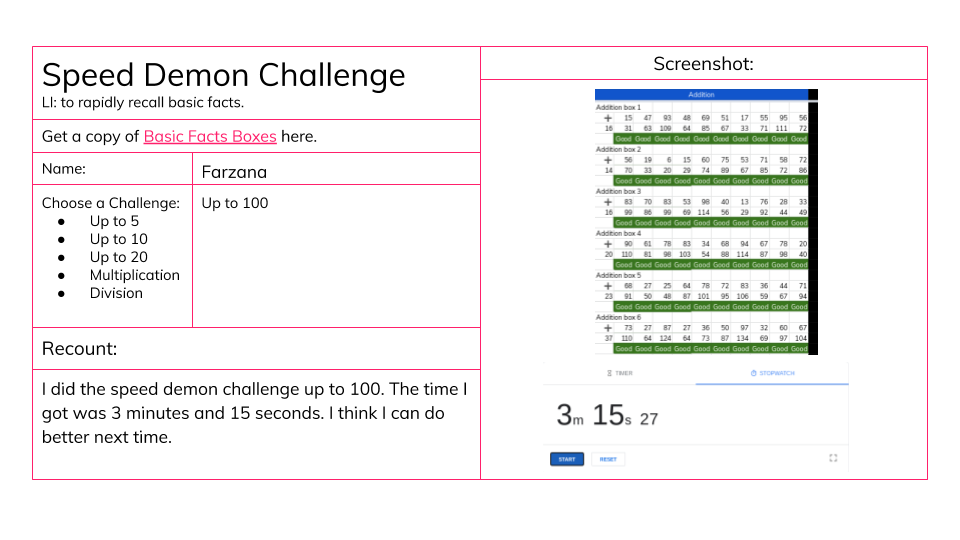
Today I completed basic fact boxes up to 100. The objective of this challenge is to get quick at answering basic fact questions. I answered the equations in 3 minutes and 15 seconds. I think that I can do better and get faster at basic fact boxes.

LI: To rapidly recall basic facts.


Safety Plan

In this activty, we built an idea of the possible risk, hazard and consequence. We also created a safety action plan that could help in a situation.

First, we discussed what risks and hazards are. Our idea was that a hazard is a something that can cause harm to people, properties or the enviorment. A risk is the chance that a hazard can cause harm to people, properties or the enviorment.

Next, we made the safety action plan. We thought of a simple activity that can take place in the school. We wrote down the year level, the number of helpers, the numbers of students and the location of the activity. We also noted down the consequences, the hazard or risk, how we could prevent the consequence, the person who is responsible for the hazard or risk and the emergency plan.

I found this activity challenging because it was hard to come up with many consequences and emergency plans. The objective of this activity was to identify the likelihood of a risk and hazard to happen during an activity.

LI: To assess risk with a simple activity.

Narrative | The Gruffalo

A rewrite of a narrative gets ideas from the story and changes them to make a new story that flows with the storyline of the original story.

Thinking of the story, and the guiding questions people come up with new ideas to change the story. The guiding questions were: where would they live?, where would they meet the mouse?, what would the Gruffalo's favourite food be including them?

The fox was changed into a coyote because they are similar. The underground house was changed to rocky house because coyotes make their dens in rocky crevices. Instead of roasted fox, the Gruffalo's favourite food is coyote macoroni because it rhymes with 'coyote'. 

Rewriting a narrative can help with coming up with new creative ideas that can flow with the story.

LI: To rewrite a narrative.

Wednesday, 16 September 2020

Time | Statistical Investigation

Rounding is a maths strategy that simplifies a number to the nearest, one, ten, hundred and ect. Addition is a maths stategy that connects a number to another number. Division is the process of sharing/separating a number equally.

To round a number like: 24.83, people usually look at the last decimal which is '3'. If the number is 0-4, people should round down. If the number is 5-9, people round up. The last decimal point is 3, so round down. When rounding down, the second number does not change. The number changes to 24.8. If the number was 24.27, round up. The second number would change to 24.5.

When adding a decimal number, people round the number to make it more easier. Adding decimal numbers is like adding whole numbers. If the equation was: 17.46 + 19.39. Add the 0.06 and the 0.09 together. 0.06 + 0.09 = 0.15, because the 10 shifts to the tenths column. Then add the 0.4 and the 0.3. 0.4 + 0.3 = 0.7. After that, add the 0.15 and the 0.7. 0.15 + 0.7 = 0.85.

Dividing a decimal number is the process of sharing the number equally, between things. For example: if the equation was, 95.55 ÷ 5. First divide 95. 95 ÷ 5 = 19, because 19 x 5 = 95. Then divide 0.55. 0.55 ÷ 5 = 0.11, because 0.11 x 5 = 0.55.

These maths strategy can help people get quick at answering equations and also help with future events.

LI: To investigate units of time.

Monday, 14 September 2020

Making Connections

Connections allow people to connect with theirselves, another text and the world. There are three kinds of connections. Text to text, text to self, text to world. 

Text to text, means to make a connection with another book. To make a text to text connection, the reader gets ideas from another book and compares that idea to the book. An example is: The mouse is a convincing liar and the wolf in Little Red Riding Hood convinces Red Riding Hood.

Text to self, means to make a connection with yourself. To make a text to self connection, the reader gets ideas from the text and compares the ideas with themselves. An example is: The snake is Gullible, I am gullible.

Text to word, means to make a connection with the world. To make a text to world connection, the reader gets ideas from the text and compared the ideas with the world. An example is: the mouse is cocky, people are cocky.

Making connections can help people link ideas with other ideas and lets people build an understanding of a text.

LI-To identify and describe connections.

Friday, 11 September 2020