Wednesday, 4 August 2021

Greetings in Te Reo Maori

LI: to create a display poster that shows people the difference between tena koe, tena korua and tena koutou.

Our focus for the Te Reo Maori challenge this week was to talk about the difference between tena koe, tena korua and tena koutou when greeting people. Tena koe is a way of greeting one person alone. For example, when I meet one of my friends I say "Tena koe, kei te pehea koe?". By adding "kei te pehea koe?" to the greeting, you ask how your friend is. 

Tena korua is a greeting to two people. If I am with two of my teachers, I say: "Tena korua (teachers name) & (teachers name), he aha ake?". He aha ake means what are we doing? You can say this when speaking to two people. 

Tena koutou katoa is another greeting but to three or more people. An example of this is "Tena koutou katoa, kei te pehea koe?" which translates to "Hello everyone, how are you?". 

Mindfulness Reflection

LI: to practice mindfulness when in stressful situations. 

Mindfulness is training your mind to become aware of not only yourself, but also your surroundings. When it comes to mindfulness, there are two zones. The red zone and the green zone. The red zone is all the negative emotions you feel when stressed. The green zone is all of the positive emotions which help you when feeling stressed. For example, when in a stressful situation, you can clear your mind and stay calm. This is when your mind enters the green zone. In the red zone, you feel waves of negativity overcoming your mind. 

When trying to focus, your mind wanders. Although your body can be present, your mind can be wandering around and thinking about the past or future. With mindfulness, you focus on the present moment and what is happening at that moment. 

The mindfulness practice helps you clear your mind, focus on your breathing and overall makes you content and composed. To do this activity, we faced away from others to be focused. We had a straight back, soft stomach, closed eyes and our hands on our knees. When the mindfulness bell rang, we calmed ourselves and focused on our breathing. When breathing, you are more focused on you and your surroundings.

Monday, 2 August 2021

Olympic Maths Challenge

LI: to use the most efficient strategy to find the answers.

Today, we were looking at how we could solve another Olympic word problem. First, we gather the needed information. There are 250 squares in a badminton racket. With this piece of information we move to the next step and find out how many right angles in one square. Looking at a square, we see that there are 4 right angles per square. This means that the number problem is 250 x 4. When we multiply 250 four times, it gives us an answer of 1000. Therefore the answer to the question "How many right angles are on an entire badminton racket?"  is 1000.

Friday, 30 July 2021

Y-Chart

LI: to make inferences about the events in the text using clues provided by the author.

Our focus was based around inferring what athletes were thinking, seeing and wondering during the Olympics. In order to do this, we looked at an image which had information that we could point out to form our inferences. By looking at the images, we could see that the athletes had completed the swimming and are taking an after photo. Some inferences we made for feel/see were: the athletes might have felt nervous and cold, they could have been proud of what they accomplished, seeing their names of the scoreboard and how they felt determined to win. 

The image shown on the DLO was of Violet Walrond and other athlete competitors. Violet Walrond was a young athlete who competed in the Olympics at the age of fifteen. She was the youngest and first ever swimmer in New Zealand to use the crawl technique. Violet also was the first female to compete in the Olympics, representing New Zealand.

Topic 8 - Acids and Bases

LI: to learn about acids and bases.


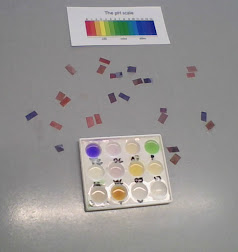
Our focus today was about looking at the acidity/base level of different substances. We got into partners and answered some questions using our prior knowledge. After this, we looked at the different substances we would be using today. 

In order to measure the pH balance or scale we used litmus. Litmus is a piece of paper that has the ability to change colours depending on the acidity, base or neutral level of a certain substance. If you take an acidic substance and dip the red litmus paper into it, it will stay the same or get even more darker. If you dip the blue litmus paper into the acidic substance, and it turns red, it is acidic. We tested 11 substances. Before testing them out with the litmus paper, we predicted what substances are acidic, neutral or basic. After that, we tested them out and checked to see if our predictions were correct. I enjoyed this activity a lot because I am familiar with pH balances. 

Thursday, 29 July 2021

Provocation | Olympic Money

LI: to use provocation to understand both sides of a story.

Our focus this week for reading was based on the Olympics & provocation. We used provocation to understand both side of the question asked. The question was should host countries spend so much money on building the Olympic venues? Our opinion was that host countries should not spend a massive amount of money on the olympics, since the former buildings used to host the olympics. We think that the billions of dollars used to other countries are facing difficult times. We found this task interesting because seeing both side of the story meant different people see the story with different opinion.

Superfingers Challenge

LI: to recall our time tables quickly.


Our focus for this activity was based around recalling our time tables fast. The objective of the game was to remember our time tables and say them quick. To play this game, we pick a word and roll two dice that go up to 12. After doing so, we look at the dice and multiply the numbers. If one of the dice roll on 6 and the other on 3, we go 6x3 and say the answer (18) as fast as we can. The person who gets the answer correct fastest, erases one letter from the word. In the end, if you answer the equations and have no letters left, you are announced the winner.

First, we chose a partner to challenge. Whoever won out of the pair gets to challenge another person who won from their pair. The person who won that goes onto the quarter finals, then the semi-finals and then the finals. The person who won the finals is the winner and fastest person to recall their time tables. Afatia won the finals against Chris. I enjoyed this activity a lot because it was fun and also got us to recall our time tables faster. I impressed myself when I was challenging Ong because I said the answer really fast at some times.