Light is an element that makes things visible. Property is a characteristic or attribute that something owns.
One property of light is that: light can’t show through opaque (not able to see through) objects. The experiment showed that when Chisa covered the light with an opaque object the light didn't go through the opaque object.
Another property is that: light can create a rainbow because the prism shows all the lights colours from red to violet. The experiment showed that when Mr Wong put the flashlight on top of the prism it created a rainbow. This is because the prism seperated all the colours from red to violet.
Another property is that: light changes positions depending on the angle of the mirror. The experiment showed that when Chisa put the mirror in front of the flashlight on an angle the mirror reflected off it and when in another direction.
There are more properties of light on the DLO.
LI: To observe the properties of light.
Thursday, 4 June 2020


Wednesday, 3 June 2020
Basic Fact Boxes
Today I completed the subtraction sheet three for basic fact boxes. The objective of this challenge is to get quick at answering basic fact questions. I answered the equations in 1 minute and 26 seconds.
LI: To remember basic math facts.


SSR Selfie | Traits and Heredity
Today I completed the SSR Selfie can-do. The objective of the SSR Selfie can-do is to learn how to summarise or retell a text. The book I read was called: 'Traits and Heredity' by Joseph Midthun and Samuel Hiti. The book was very interesting and I learn many new things about the traits and heredity of animals and humans. One thing I learned was that: One variety of corn may resist disease better than another variety does.
LI: To summarise and retell a text.

Tuesday, 2 June 2020
Plurals | Writing
Plurals are more than one thing. Plurals have many rules to them, they also have exceptions.
Most nouns have an 's' at the end to make it plural. However, if a noun ends with a 'y' then people often change it to an 'i' and add 'es' to the end. For example: bunny, bunni, bunnies.
If a noun ends with 'f' or 'fe' then people often change if to 'v' or 've'. For example: wolf, wolves. There are some exceptions to this rule. For example: belief, beliefs.
Plurals can help with identifying the amount of something.
LI: To describe objects using specific and interesting nouns and adjectives.
Most nouns have an 's' at the end to make it plural. However, if a noun ends with a 'y' then people often change it to an 'i' and add 'es' to the end. For example: bunny, bunni, bunnies.
If a noun ends with 'f' or 'fe' then people often change if to 'v' or 've'. For example: wolf, wolves. There are some exceptions to this rule. For example: belief, beliefs.
Plurals can help with identifying the amount of something.
LI: To describe objects using specific and interesting nouns and adjectives.
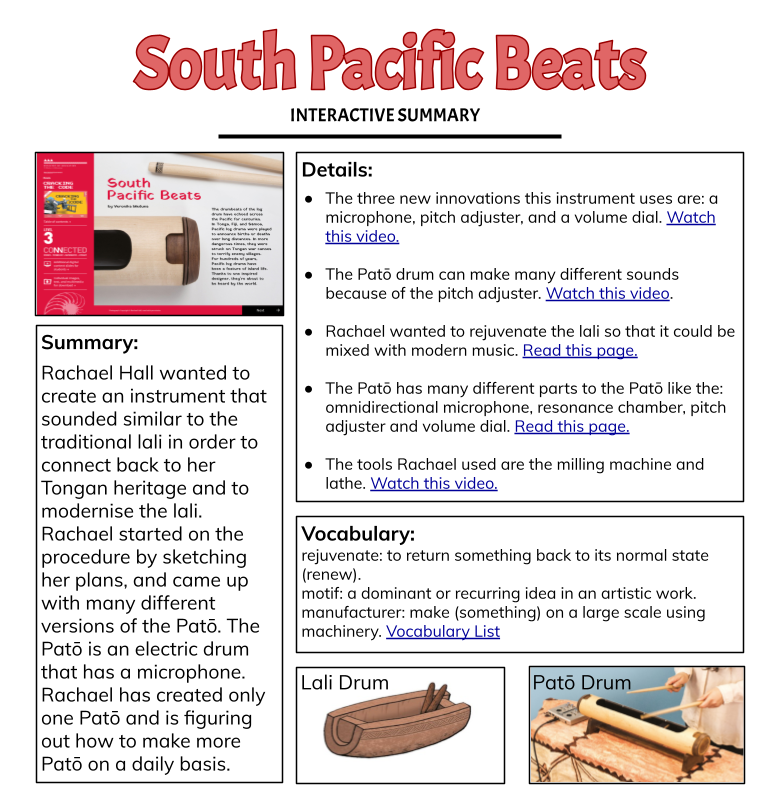
South Pacific Beats | Interactive Summary
We were making an interactive summary about the article South Pacific Beats. The first thing we did was to learn the reading strategies that helped us understand the text.
The reading strategies we practised were: prior knowledge, visualising, skimming and scanning. Prior knowledge is when you already know things about the topic of the text. Visualising is the process of understanding some of the text and then drawing what you understand. Skimming is when you read a text quickly to understand the general idea of the book. Scanning is when you look for specific information in a text.
After that we looked at the vocabulary. Vocabulary is when you define the words that you think someone doesn't understand or you think you don't understand.
We read the article until we understood the text. After that we created an interactive summary. We wrote a summary about the article then added the details. A summary is a brief description about the whole text. Details are the specific information about the book.
LI: To create an interactive summary of the article South Pacific Beats.
The reading strategies we practised were: prior knowledge, visualising, skimming and scanning. Prior knowledge is when you already know things about the topic of the text. Visualising is the process of understanding some of the text and then drawing what you understand. Skimming is when you read a text quickly to understand the general idea of the book. Scanning is when you look for specific information in a text.
After that we looked at the vocabulary. Vocabulary is when you define the words that you think someone doesn't understand or you think you don't understand.
We read the article until we understood the text. After that we created an interactive summary. We wrote a summary about the article then added the details. A summary is a brief description about the whole text. Details are the specific information about the book.
LI: To create an interactive summary of the article South Pacific Beats.
Weight | Measurement
Weight is how heavy an object or item is. The standard forms of measuring weight are tonnes (T), kilograms (kg) and grams (g). To measure these things, people often use scales or balance scale.
Estimating is an educated guess to the amount of something. If a person knows that the weight of a stick is 3 markers, then they can compare the markers on a scale. If they know the weight of the markers then they can make an estimation.
To convert kilograms to tonnes, divide the number by one thousand. To convert grams to kilograms divide by one thousand. If the measurement is 18 kg, then divide by one thousand the numbers shift to right.
LI: To explore standard forms of weight.
Estimating is an educated guess to the amount of something. If a person knows that the weight of a stick is 3 markers, then they can compare the markers on a scale. If they know the weight of the markers then they can make an estimation.
To convert kilograms to tonnes, divide the number by one thousand. To convert grams to kilograms divide by one thousand. If the measurement is 18 kg, then divide by one thousand the numbers shift to right.
LI: To explore standard forms of weight.
Subscribe to:
Posts (Atom)